Earlier this year I committed to going deep into the world of AI. I completed courses from Google, Databricks, Coursera…the usual suspects. I learned a lot. But it wasn’t enough. I wanted to learn by doing, not reading. So I took a leap and built an app. I learned a ton along the way. This is that story.
Part 1: A Screenplay, a Spark, and a Revelation
The Screenplay that Changed Everything
I'll give away the headline: I thought AI would give me better work. Instead, it gave me a better way to work.
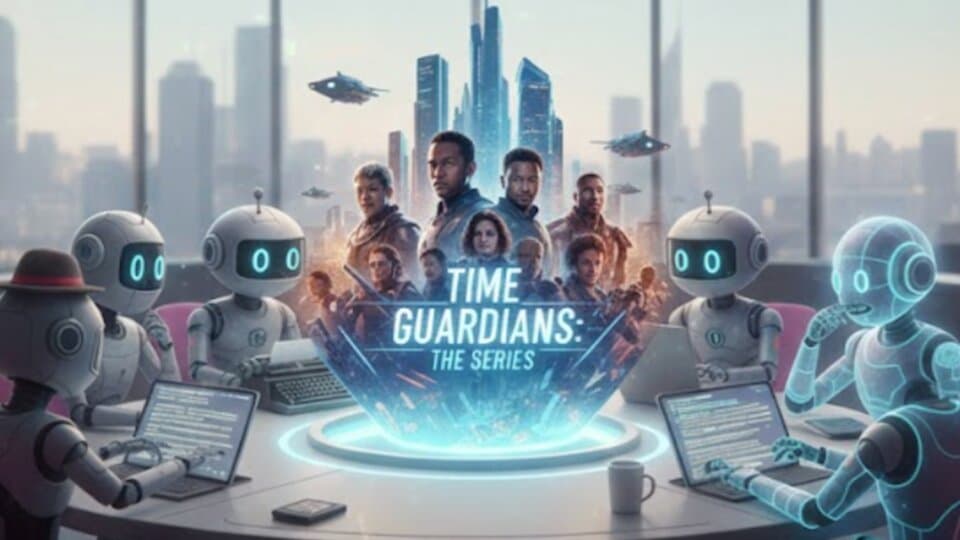
It started with a screenplay. A book adaptation called “Time Guardians” - a YA time-travel/adventure series we developed pre-COVID, when selling to streamers still felt possible. We got some bites.
But we didn’t land a deal. One reason surely was because it was twenty pages too short, drowning in exposition, and missing two episodes to showcase the strength of the series (it really is awesome.) I couldn't fix it alone, and hiring a real writer wasn't in the budget. So the script went in a drawer. It sat there for years, gathering dust, representing lost dreams.
Fast forward a few years. I’m deep into my AI learning plan, reading about the power of AI as a "thought partner." I was intrigued. A lightbulb went off! What if I could sit in a room with JJ Abrams, Damon Lindelof, and Michael Chabon, not to ghostwrite my screenplay, but to spark ideas? To ask the hard questions. To guide me in the process, and maybe teach me something about story (adding Robert McKee to the mix really kicked my ass.) To help me finish what was started.
So I opened Claude and started building a writers’ room.
The first six attempts failed.
Not "didn't work perfectly" failed. Hallucinated-plot-points, contradicted advice, forgot-what-we-discussed-yesterday failed. I'd establish clear character rules and the AI would break them four exchanges later. I'd ask for honest feedback and get sycophantic applause.
I deleted those chats and started over. Each time, I learned something:
- (AI) Personas need constraints, not just descriptions
- "Be helpful" is the enemy of useful creative feedback
- “Lazy”, incomplete, or vague prompts will surely blow things up quickly
- The room needs direction about roles, responsibilities, and the cadence of persona actions
- Silence is a valid response - not every persona should weigh in on everything
By attempt seven or eight, something clicked. The personas held. The work was good. I had my writers’ room.
Process Beats Outputs
I shared that old pilot with Damon, JJ, Michael and Robert. They disagreed with each other productively. They pushed back on my bad ideas without being jerks about it. They helped me get organized, and taught me story concepts (“you’re in desperate need of the Mystery Box” - thanks JJ.) They remembered our decisions and built on them. Things got productive. It was a blast!
That's when I realized I'd been thinking about AI, and creative workflows, all wrong.
Everyone talks about AI outputs: what it generates, what it writes, what it produces. But the real value wasn't what the personas handed me. It was what they catalyzed in me. The ideas I generated from the interaction, not the ideas they gave me.
I worked with my writers’ room all weekend. The work got better and better. I had a new, completed pilot, a second episode, and a third underway. I generated more original ideas from engaging with AI than were ever handed to me.
It wasn’t about the output. It was about the process.
The Counterintuitive Discovery
The writers’ room worked in Claude, but it lived in a chat window. I couldn't manage drafts, track versions, or easily output to industry-leading tools like FinalDraft. I saw an opportunity to use AI to generate beat-sheets, build treatments, even run script coverage. So I decided to build an application that would expand on the writers’ room concept with tools that took the workflow to another level.
I dove into vibe coding. I started into Google AI Studio and built a working prototype in a matter of hours. I set up my first Github! I integrated APIs from Claude and Gemini. Later I would move into Firebase Studio, and then quickly into Antigravity.
I’ve led content and product teams, and now I was working with a coding partner and building a multi-LLM powered app! I had a functional writers’ room application for today’s content creators. I designed 50+ AI personas, created functional drafting tools, built story management features, and architected AI-orchestration to manage deterministic and probability tasks. I ran token models and optimized token economics. I journeyed through numerous UX/UI iterations, broke the app multiple times, and came out with a fully functional MVP.
But the challenges grew, not because the code was impossibly hard, but because everything I'd learned about making the AI collaboration work didn't automatically transfer to a software product.
The personas drifted. The orchestration broke in subtle ways. At one point, I discovered the wrong AI model had been running the entire system. And I only noticed because the quality of the collaboration felt off. Not an error message, or a bug review. It was a feeling. And almost every issue discovered came from my code review and questions, not the AI agent.
That's when I learned a second lesson: AI management is as important as AI capability.