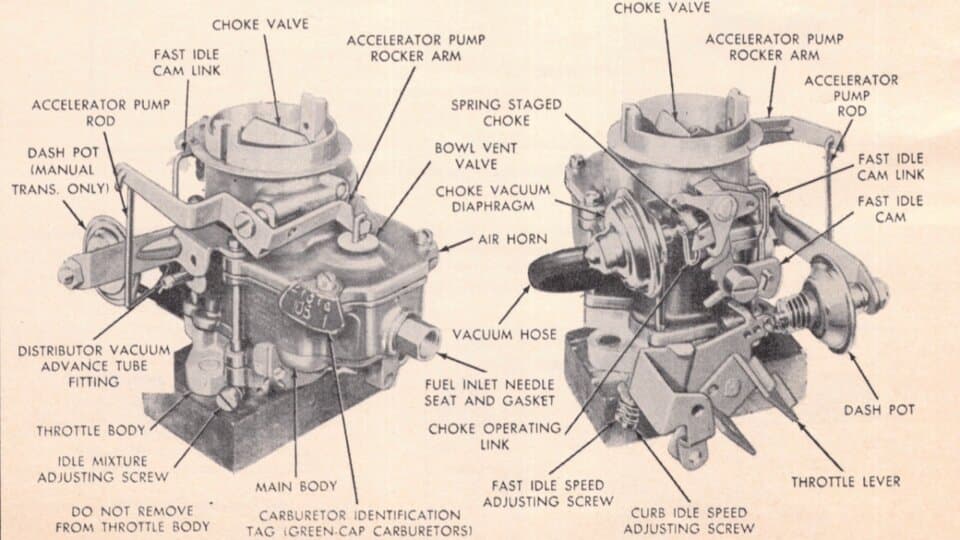
I rebuilt a 1964 Plymouth Valiant carburetor last weekend. A totally new experience. It was inspired by my friend Sterling Hawkins and his book, Hunting Discomfort. I've been actively searching for uncomfortable experiences as a means to disrupt my routines and thinking. "Let's try our hand at auto engineering and not blow up the house in the process," I thought.
With diagrams and specs spread out in front of me, I started the dismantling process. Covered in grease, gas, and gunk, I learned all about the inner workings: which part controlled which function, where the dependencies were, the correct ratio of gas to air. Trying hard not to lose a part, or break one that's working just fine.
Step by step, I cleaned the chamber, installed new gaskets, and cut fresh hoses. Reassemble and reinstall… It worked! Until it didn't. Gas started pouring out of new places, pooling on the manifold, spraying the hood. Fumes filled the garage and the house. The wife was not happy.
I started troubleshooting, tearing the carburetor down while it sat on the engine block, inspecting every piece for debris or a faulty part. I shared pictures with AI, which was somewhat helpful, even as it suggested a fix for a totally different carburetor model.
Found the issue. A torn rubber needle tip and a misaligned float (similar to how a toilet float works), designed to trigger the gas cutoff. A piece no larger than ⅛ of an inch had me calling classic car repair shops in a panic.
Luckily I had a replacement part. Made the fix, turned the key, pumped the gas, held my breath… engine fired up. No leak! Sweet relief.
Isn't this exactly how life works? We operate inside complex systems, dense with connected and moving parts designed to enable efficiency and performance. And all it takes is one unseen breakage of something small and innocuous to throw everything into chaos. Panic creeps in. Performance falls. Results miss the mark.
Especially when we're talking about human beings working with other human beings. Communication breakdowns are one of the most common versions of the proverbial "rubber tip" I've seen — one person not sharing information, or not considering who else needs to be included, can bring the entire system to a halt. Now expand that across teams, business units, partners, customers — the enterprise. Gas leaking from the places you see, and the ones you don't.
This started as a piece about hunting discomfort in creative ways. It became an all-too-real metaphor for breakdowns. You can watch the gas leak and pass out from the fumes, or you can go digging, find the source, and repair the critical issue to get things working again.
Every organization has a rubber tip somewhere. A 'torn seal' in the handoff between sales and delivery, a 'misaligned float' between what leadership says and what teams actually experience, a poor 'idle setting', like a gap in information sharing that nobody owns. It's rarely dramatic. It's an 'eighth of an inch'. And it will keep leaking until someone's willing to get covered in grease and go find it. This requires discipline, commitment, and being open to the challenges and opportunities at hand.
The engine already runs a certain way, leaks and all. The question is whether you're willing to pull it apart and find out why, or keep topping off the tank and calling the fumes normal, silently praying that a spark doesn't cause a catastrophe.
I found the source of my leak. Where's yours?